BIO

Noemi Iglesias Barrios (Asturias, 1987) is a visual artist whose practice focuses on porcelain sculpture, long-duration performative formats, and digital processes. Her work investigates how romantic consumerism and the material production of emotions in contemporary culture are encoded through patterns of consumption and everyday cultural objects. She integrates handcrafted processes with digital approaches, questioning the boundaries between craft, industry, and technology.
She has lived and worked across diverse international contexts, shaping a nomadic trajectory and a transversal perspective on traditional crafts, industrial techniques, and their application within contemporary art. She holds a Fine Arts degree from the University of the Basque Country and an MA in Porcelain from Tainan National University of the Arts (Taiwan).
Her work has been presented at institutions such as the Thyssen-Bornemisza National Museum and Fundación Telefónica in Madrid, the Onassis Foundation in Athens, LABoral Centre for Art and Industrial Creation, iMAL – Center for Digital Cultures (Brussels), Gimhae Clayarch Museum (South Korea), Aichi Prefectural Museum of Art (Japan), Yingge Ceramics Museum (Taiwan), as well as galleries such as Moisés Pérez de Albéniz and Espacio Líquido. She has received awards including the European Digital Deal by Ars Electronica, the National Printmaking Prize María de Salamanca, and the Fundación Unicaja Craft Prize.
Her work has been featured in national and international media such as Forbes, Vogue, Harper’s Bazaar, and Libération. She is currently based in Asturias and completing a PhD in Sculpture at the University of Fine Arts of Lisbon, where she continues to expand her research into the intersections between affect, materiality, and digital culture.
STATEMENT
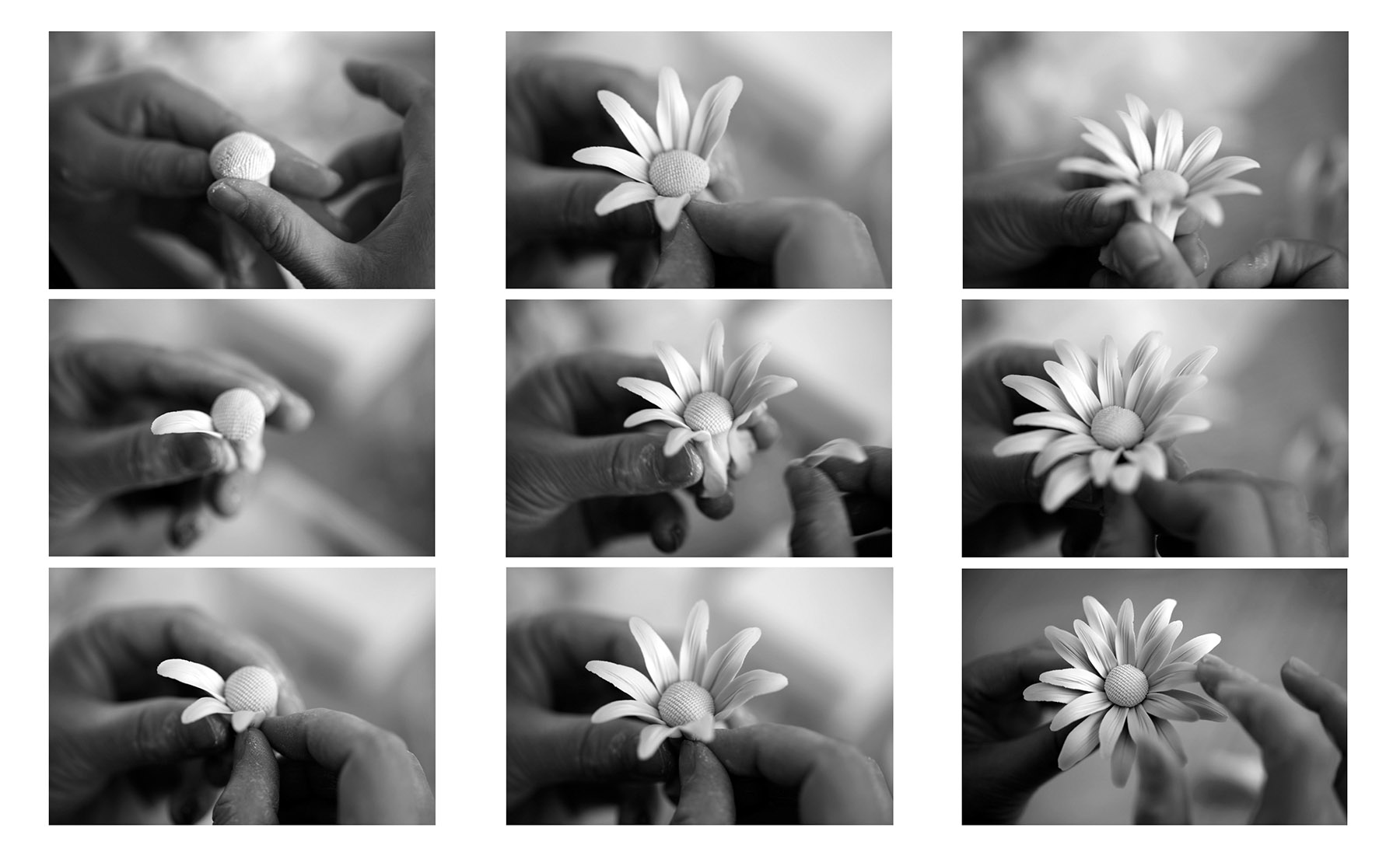
The technique of ceramic floral production is an industrial job that was entirely performed by women throughout the nineteenth and twentieth century in European ceramic factories.
In a hierarchically patriarchal framework, such as the industrial environment, female presence has always been a clear example of labor segregation that resulted in wage inferiority and therefore an economic dependence on women with respect to male workers.
In my work, I reproduce this floral industrial technique to outline the current commodification of falling in love and how emotional patterns are socially assumed as comercial icons in the production of a romantic utopia where sentimental experiences are presented through specific products manufactured by the industry and transforming emotional patterns into consumerist strategies.